Sunday, October 5, 2008

Peanuts & Thermo.

Linus seems to have a firm grasp of Thermodynamics. This was the peanuts comic strip for today, and I thought it was perfect timing.


Now I would relate this, also, to my life... I would be Linus pointing out these issues and my girlfriend would be Lucy...

Saturday, October 4, 2008

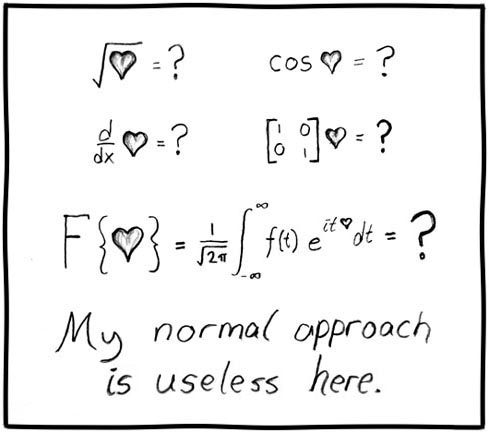
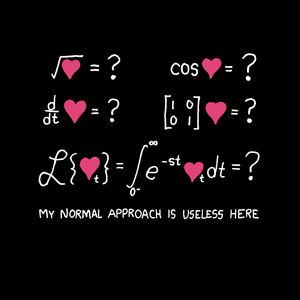
Normal Approach


XKCD Comic #55... absolutely hilarious! And now for an XKCD variation which appears on a t-shirt which changes the Fourier transform to a Laplace transform. Pure genius.

Statistical Mechanics

For my first instalment of class descriptions I have chosen to write about the undergraduate course I am taking as a "filler". Now, it's deemed a filler due to the fact that I have taken Thermodynamics already, at Oswego, but have not had Statistical Mechanics (Stat. Mech.), so in order to prepare for my graduate level Stat. Mech. course in the Spring, I need to fill in the gaps.

You may be wondering, if you're not a physicist, which I'm guessing most people aren't, what is the difference between Thermodynamics and Stat. Mech.? Or, for that matter, what about them is the same; how are they related? This takes a little prior background knowledge to explain, so let me teach you a little qualitative physics which explain the two topics. Thermodyanics is the study of energy, and for that part, so is Stat. Mech. Mainly, the conversion of energy and the transformation of energy from one form to another is the primary focus of both topics. For example, heating a cup of coffee in the microwave turns electrical energy into waves which in turn vibrate the water molecules in the coffee, thus increasing the average kinetic energy of the particles. As a result, this increases the temperature of the coffee. During this whole process, though, energy is conserved in one form or another. We know that in the Universe energy can not be created or destroyed, only converted into different forms. So in manner of speaking, thermodynamics is the study of the conservation of energy.

The primary difference between Stat. Mech. and what I had, Classical Thermodynamics, is the treatment of the system which they study. In Classical Thermodynamics, the treatment of the processes are done on a macroscopic scale (large). When working in this area, we are not concerned with the physics of the individual molecules, only the system as a whole. This is great for engineering, but from the aspect of a physicist, we want to know everything that is happening with in the system. We take a look at the microscopic state (microstate) of the system and how that relates to the macroscopic state (macrostate). In order to do this, though, we can't describe each particle or molecule individually, that would be ridiculous considering that one mole of gas contains 6.023x10²³ molecules! Also, since we are dealing with microstates and with molecules and particles we have to treat the system quantum mechanically. In order to circumnavigate the difficulties of the shear size of our system, we utilize statistical tools for study the molecules. Molecules and particles don't all act in the same manner, but, they do act similarly based on probabilities. Thus, we may not be able to say exactly what a particle is doing before we observe it, but we can calculate a probability for what it is doing. In this fashion we can evaluate a large number of particles very easily and thus formulate the physics of the macrostate from knowledge of the microstate.

The course, thus far, is fairly straight forward and honestly, rather easy. It helps that the textbooks we are using are very verbose and contain great descriptions of the physics, not only in terms of mathematics (quantitatively) but also in basic words (qualitatively). The two text books for the class are as follows:

"Fundamentals of Statistical and Thermal Physics" by Frederick Reif (1965)
"An Introduction to Thermal Physics" by Daniel Schroeder (2000)

Both are good books, very descriptive - but I find that Reif is the more thorough book. This is mostly because it is clearly meant for upper division undergraduate course work where Schroeder could be utilized for a Sophmore level class. Schroeder, though, is a much better writer in terms of "dumbing" the material down and creating an active reading environment, whereas Reif is a little more dull in his writing but is very thorough and intensive. I personally enjoy reading Reif more (incorporates more quantum aspects). This course is definitely a good relief from the rigor of Classical Mechanics and Mathematical Methods, both of which are intensive graduate courses.

Wireless

Finally! Three weeks after having moved into my apartment in West Lebanon, NH, I was delivered a router allowing me to set up a wireless network. Now, I say finally as if I had been waiting for a delivery guy for weeks... no, that's not the case at all. In fact, I didn't have to pay for this one! I was waiting until I had a paycheck or two put away before I invested in a router. Luckily, though, I was able to obtain one for free and considerably sooner than I had anticipated. It is such a nice feeling to finally be able to unplug in my own apartment and not have to sit on the floor so that I can reach the modem with my ethernet cable! So hopefully, or so it's the plan, I'll be on my computer more often at home after the long hours in the office at Dartmouth which will in turn, lead to me blogging more often. We shall see!

Friday, September 26, 2008

Graduate Courses

So I have had my first half week as a Dartmouth Graduate student. This involved three days of classes, Wednesday-Friday. This term (yes term, we're not on the semester system) I am taking 5 courses, two of which are "seminar" classes. I'll explain in a bit. The other 3 courses that I'm enrolled in are Physics courses, the ones that deal with material that will end up on my PhD qualifying exam in a years time. These courses are as follows: Statistical Mechanics, Mathematical Methods, and Classical Mechanics.

The physics courses constitute most of the time I will spend in my office this semester... oh yeah! I have an office, not to myself, but with the other first year graduates. In total, I am one of 7 in the office, a large office with about 10 large desks and numerous filing cabinets. Needless to say, we have a lot of room around us and are quite comfortable in our own niches. This comfort, though, is great to facilitate learning; being around the other students whom you can talk things over with, it's quiet, located on the third floor of the Physics and Astronomy Building (Wilder Hall) away from the lecture halls and most of the traffic in the building, and finally, it's comfy and there is nothing else to do but do homework and read... this is good for someone like me who enjoys procrastinating.

The two seminars are courses on "Scientific Integrity" and "Teaching". Here we learn about ethics in the lab and in our work in general, including homework and then we learn how to TA, respectively. The seminars are important to our education and although they add a work load to our already immense work load, I welcome these courses.

In the future I intend to write about each class individually, describe the content and a little about the material specifically as well as the text book(s) that we are using. I think it will be a good insight into what really goes on in class and what I'm really learning.

Tuesday, September 16, 2008

Welcome to Dartmouth

I have tons to write about but am currently sitting in my office with the intent of studying for my "no fault" qualifying exam on Thursday, but am I? No, not really. I am going to be brief though and just inform the public that I have moved into my apartment, taken care of all my paperwork and have had my first year orientation. Now, the fun begins and I embark on a journey of hell. Off to study and try and get a little review in before my qual... and oh yes, I register for classes tomorrow. More later, I promise.

Monday, September 8, 2008

Last March of the Ents

First, there's a crack of the wood as the grain pulls apart, followed by the thud of the maul slamming into the chopping platform below the log. It's actually nothing fancy, just a larger piece of the trunk from a tree that we had cut down recently. The tree was dying and would have caused massive damage no matter what direction it fell; either on our house, our cars, the shed and everything inside, or into the moderately busy street we live on here in the woods of New Hampshire.

I rather hate the idea of cutting down trees; they have a striking beauty about them as they stand towering over all the creatures and beings living below. Trees are wise, having seen many hundreds of years, these trees have witnessed more history than any other individual being. I believe that all animals, including humans, have a connection with nature, all living in harmony with one another. And though humans have seemingly lost touch with nature, the connection still exists, even if it might be the minute remnant of what it once was. We have squandered our relationship with nature, hacking, slashing and burning our way in order to be ever more "civilized"... for apparently the more you destroy and overpower nature the more civilized you become by today's standards. Why is it that we have taken such great advantage of the beings that have fostered our creation and evolution? Is it the lust for power over all that is, was and ever will be? Or maybe something more simple, a lack of understanding for just how much nature is apart of our lives, both past and present?

Plants and animals have bore disease among us, yet they also provide the solutions. Would we vanquish the man or woman who has found the cure for HIV/AIDS? What about the one who discovers a serum which causes Cancer to flee the body? We would not bring death among these people, nay, to the contrary, we would propel them to a level of glory which would be envied by the kings of old. So why then, are we reigning death among the natural world? Our fellow man may never discover the cures of our worst ailments without Her. If just one species of plant is burned into extinction before it's properties can be analyzed, we may miss out on the opportunity to triumph over these illnesses.

The unnatural death of a tree fills my heart with sorrow, as if a part of my soul has died as well. I did not agree with the decision to put an end to this tree's life. Although it was old and withering, it's leaves, hardly budding, it still had some life to live and it had the intention to do so. Just as we would not end the life of an elderly person, just because their skin is wrinkled, we should not end the life of a tree which has not gasped for it's last breath, a breath which provides us with our next, transforming CO2 into Oxygen which we inhale and expel CO2, the next breath for the tree. Harmony. Life as we know it would not exist if it were not for plant life.

So how then, can I enjoy chopping wood, knowing that a tree must have died for it to be possible. While occasionally I find myself chopping wood that has had the misfortune of being at the mercy of the human will, I have no argument against chopping wood that has past due to natural causes. Silly... maybe to you, but not to me. The time honored tradition of chopping firewood puts me at ease, relieves my stress and allows me to, even just for a moment, escape the fast paced world that we exist in.

Chopping wood is as much a honed skill as it is a measure of brute force, in fact, I would take a more accurate and intelligent chopper than the strongest brute. Finding the right fissure in the grain and exploiting the natural characteristics of the wood takes a bit of thought and planning followed by an accurate swing. If the appropriate technique is applied with some forethought, little to no effort is needed aside from the raising of the axe (or maul). It is a satisfying way to pass the time and still accomplish a needed task, a task that I would gladly perform any day - especially in the winter... there is a much greater aura surrounding chopping in the winter. It brings me great pleasure, indeed.

Once again, I have found myself rambling on about topics that I did not intend to ramble on about. My aim was to speak of the proper tools and technique involved in the chopping, yet here I am speaking of my philosophy on nature and relationship with trees. Ah well, for the next time.